
1 Overview
In advanced equipment manufacturing applications such as IC sorting and testing, die bonding, 3C FATP, and 3D dispensing, fine-grained motion control plays a critical role in processes such as sorting and assembly. Traditional motion control systems typically adopt a PC-based architecture that combines a PC for vision processing and data handling with a motion control card for trajectory control and real-time motion control. This approach integrates the PC’s computing and data-processing capabilities with the motion control card’s trajectory control and real-time capabilities, meeting the requirements of general-purpose applications.
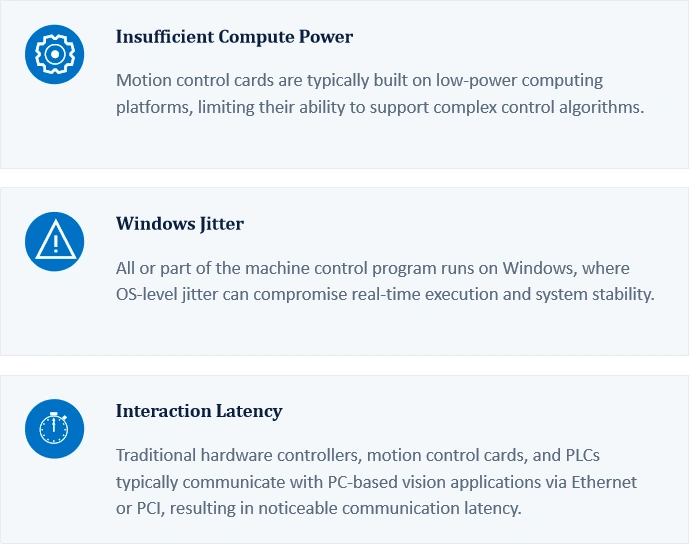
However, as manufacturing continues to evolve and the demand for more precise and sophisticated control increases, this traditional architecture is increasingly challenged by insufficient computing power, increased communication latency between the PC and motion control card, and system jitter.
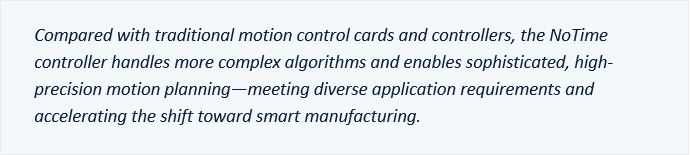
ProU software (Shenzhen) Co., Ltd. (“ProU”) has introduced the NoTime controller based on Intel® architecture, integrating vision and data processing with motion control on a Future Robot industrial computer powered by Intel® processors, along with a real-time-system-based machine program execution environment and motion function library.
2 Motion Controller Market Trends & Challenges
2.1 Market Trends
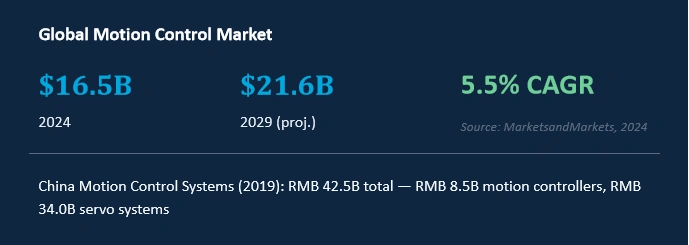
Motion controllers use processors to perform logic calculations and actuators (typically servo drives and motors) to translate planning commands into mechanical motion, achieving precise position, speed, acceleration, and torque/force control with closed-loop sensor feedback. Motion control systems are core component of high-end equipment, determining its precision and efficiency.
As manufacturers increasingly shift toward flexible and smart manufacturing, the market is placing higher demands on motion controllers in terms of scalability, latency, and computing power.
A new generation of motion controllers is advancing in information-processing capability, openness, trajectory accuracy, and versatility, enabling multi-axis coordinated motion, complex trajectory planning, real-time interpolation, error compensation, and servo filtering for closed-loop control.
Software-defined architecture is a key trend in motion control, decoupling hardware from specific functions to enable greater flexibility and scalability. With hardware-independent development platforms, users can customize motion control applications without hardware changes, accelerating solution development and time to market.
Today, software-defined motion controllers typically adopt x86-based PC platforms, leveraging their compatibility, expandability, and computing performance to efficiently handle complex workloads.
For high-end manufacturing, motion control solutions must support lean and flexible production. Beyond software-defined flexibility, high-end controllers require low latency, high stability, and efficient execution to deliver reliable and precise motion control.
2.2 Challenges
Traditional motion control systems typically use a PC (for vision processing, data processing, etc.) working together with a motion control card. However, this architecture has the following limitations:
3 Solution: ProU NoTime Controller
The ProU NoTime controller innovatively consolidates motion-control, vision, and data-processing workloads onto a single Intel® processor-based Future Robot industrial computer, with different workloads assigned to dedicated CPU cores. High-speed shared memory enables communication between workloads, significantly improving data-exchange efficiency and function execution speed between motion control and general-purpose PC applications.
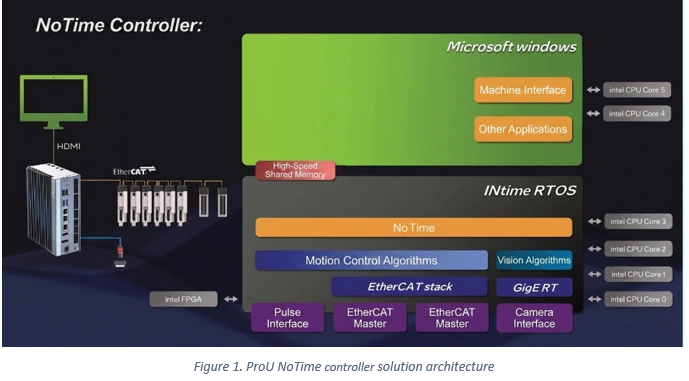
NoTime Controller Hardware
The ProU NoTime controller features flexible I/O configurations, high expandability, high reliability, and a compact, modular design, supporting agile development and rapid customization to meet diverse application requirements.
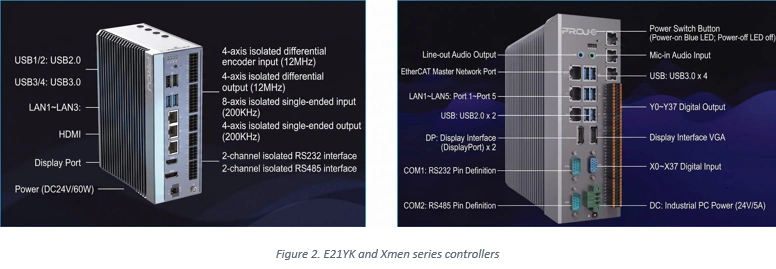
3.1 Functional Design
Powered by Intel® processors designed for IoT, edge, and industrial applications, along with technologies such as Intel® Resource Director Technology (RDT), the ProU NoTime controller provides the following key capabilities:
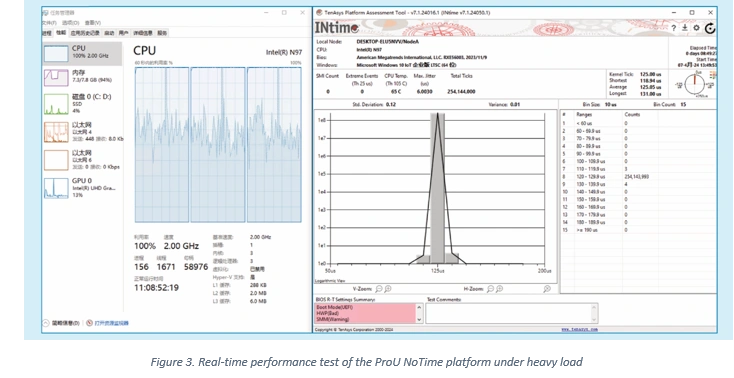
Outstanding Real-time Performance, Even Under Heavy Load
Through superior hardware and software co-design, the NoTime controller achieves excellent real-time performance. As shown in Figure 3, the NoTime platform maintains outstanding real-time performance even at 100% CPU utilization and 94% memory utilization.
Significantly Reduced Motion Control Interaction Latency
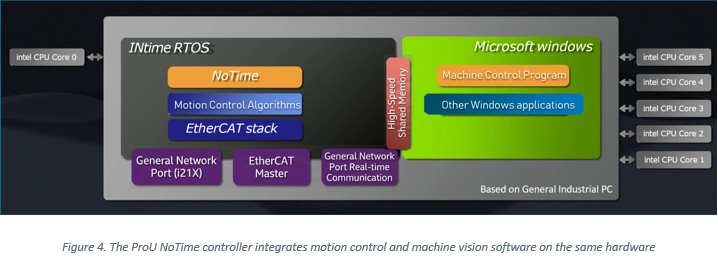
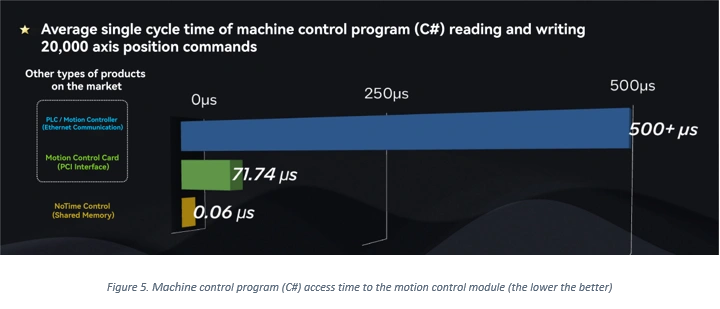
Thanks to the high-performance compute of x86 systems, the ProU NoTime controller hosts the machine control program and machine vision software on the same industrial computer. High-speed shared memory sharply improves data-exchange efficiency and motion function execution speed compared with a general PC application.
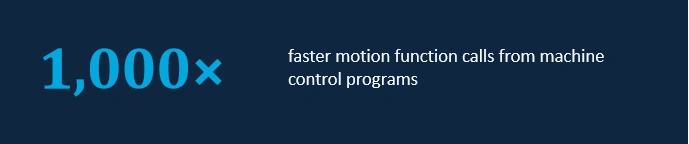
In the test, ProU repeatedly executed commands to read and write axis position data for 20,000 cycles, with the cycle time recorded for each operation. As shown in Figure 5, the motion control card using PCI communication achieved an average read/write time of 71.74 μs per operation. In contrast, the NoTime controller using shared-memory communication required only 0.06 μs per operation on average, delivering approximately 1,000× faster interaction than the PCI-based motion control card.
Improved Machine Program Execution Efficiency and Stability
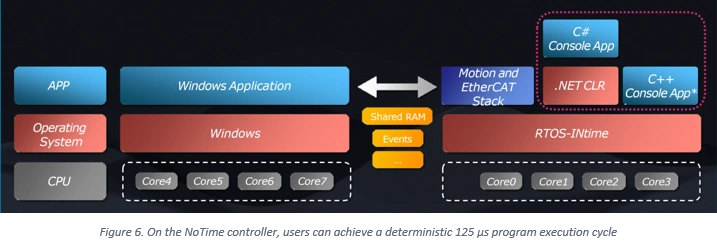
Traditional motion control solutions typically run motion control algorithms and the EtherCAT protocol stack on an embedded chip, while the user’s machine control program runs on Windows. However, Windows introduces system-level jitter during computation, which can cause the speed profile to deviate and reduce the execution efficiency of the machine control program.
In the NoTime controller, machine programs (C#, C++) can be loaded into the INtime real-time system, freeing the machine control program from the effects of Windows jitter. NoTime uses Intel® RDT’s Cache Allocation Technology (CAT) and Memory Bandwidth Allocation (MBA) to set service levels for the CPU threads and cache used by other processes, thereby capping their memory bandwidth usage and CPU cache allocation. This prevents interference with the critical machine control program and guarantees the real-time execution of the program.
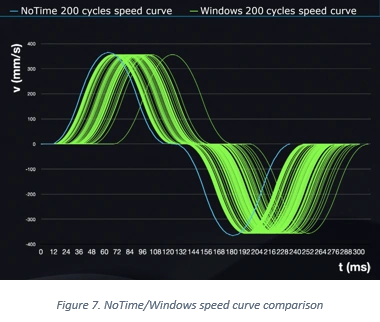
ProU conducted a cyclic motion test consisting of six I/O toggles at the same zero point followed by a 20 mm reciprocating motion. Using the same servo system and hardware, the test was repeated for 200 cycles, with the program running separately in NoTime and Windows. The speed profiles were recorded directly from the servo drive. As shown in Figure 7, the speed profile under Windows exhibited significantly greater deviation.
When CPU utilization reached 100%, the complete motion cycle took 63.34 seconds with the Windows-based solution, compared with only 46.02 seconds with NoTime. This resulted in an overall speed improvement of approximately 27%, while stability improved by 99.83%.
Provides Powerful Feedforward Control Capabilities
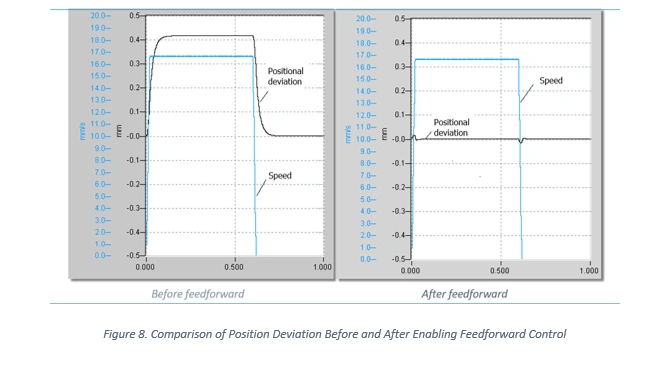
The feedforward control function of ProU NoTime controller is based on the ISG CNC algorithm library. During motion planning, it calculates not only position information but also the time delays in velocity, acceleration, jerk, and other motion parameters caused by the bus cycle and the computational cycle of the motion control system. Compensation values are then fed through the velocity-loop and current-loop offset interfaces of the EtherCAT servo drive to reduce axis position errors.
Test results show that, with feedforward control enabled, the average path deviation decreased from 0.033 mm to 0.013 mm, while the settling time at a 0.01 mm positioning accuracy improved from 13.2 ms to 10.6 ms.
Trajectory Control with Advanced Smoothing Tools
The ProU NoTime controller integrates advanced trajectory-smoothing technologies, including Hyper Space Computing and ABS Spline Path.
Leveraging the high computing performance of Intel® processors, Hyper Space Computing supports look-ahead speed and path planning for up to 10,000 control points. It also enables trajectory planning based on user-defined tolerance limits and softer dynamic parameters, helping to reduce mechanical vibration.
ABS Spline Path is a specialized smoothing tool that leverages the computing power of Intel® processors to generate Akima spline or B-spline motion paths directly from control points, along with the corresponding path and velocity planning. For geometries that make extensive use of CAD spline tools, ABS Spline Path enables high-precision trajectory smoothing while reducing the rigidity requirements of the mechanical system.
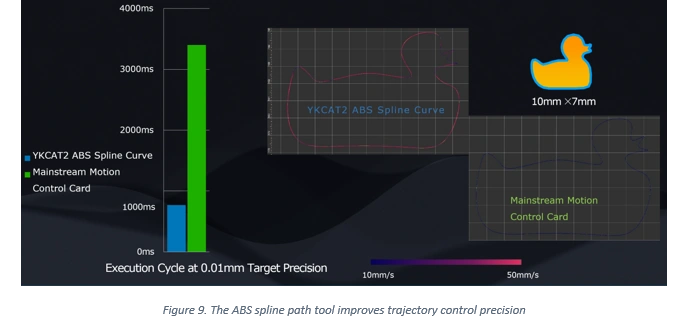
Supports Complex Real-Time Vision Algorithm Processing
NoTime Vision runs image processing algorithms and GigE communication within the real-time system, significantly reducing the latency of image processing, guidance-position calculation, and motion control, thereby improving stability throughout the entire vision-compute-motion cycle.
3.2 Future Robot Industrial Computers
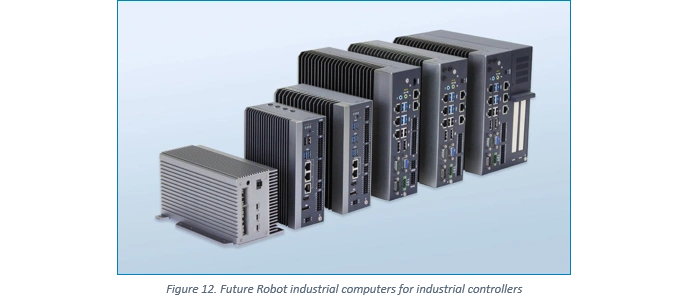
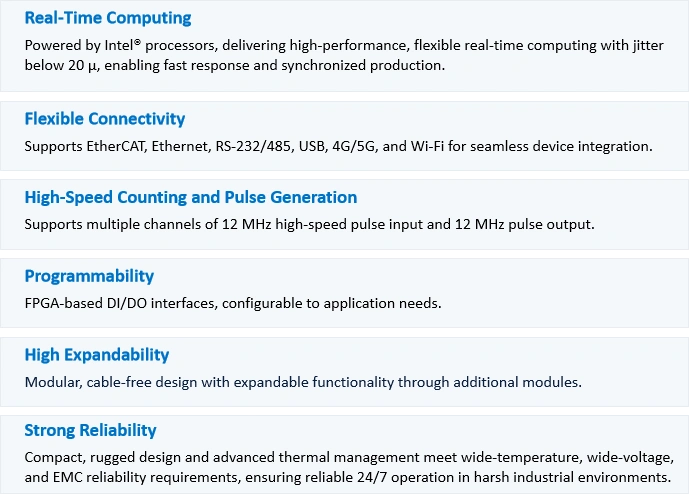
The ProU NoTime controller is built on Future Robot industrial computers powered by Intel® processors. Future Robot is a National High-Tech Enterprise specializing in industrial control, machine vision, and automation. Its industrial computers, specifically designed for industrial controllers, feature embedded, compact, fanless designs and support 12th Gen Intel® Core™ processors, Intel Atom® x7000E series processors, and Intel® Processor N-series, meeting the requirements of a wide range of applications.
Flexible, Rapid Customization
In addition, Future Robot provides agile and responsive customization services, developing products with hardware configurations and interface designs tailored to customers’ specific application requirements. It also provides tools for rapid development and deployment, helping shorten time to market.
Intel® Premium Industrial PC (PIPC) Program partner
Future Robot is also a partner in the Intel® Premium IPC (PIPC) Program. Selected E-series industrial computer products have passed the program’s hardware and software testing, with multiple products receiving PIPC validation since 2023.
3.3 Intel Technologies and Applications in Solutions
The Intel®-based ProU NoTime controller supports a range of processor options, including 12th Gen Intel® Core™ processors, Intel Atom® x7000E series processors, and Intel® Processor N-series processors. It not only enables the efficient execution of complex machine control algorithms, but also offers wide-temperature support, high stability, and remote maintenance capabilities, providing a solid hardware foundation for motion control.
The controller also leverages Intel® Resource Director Technology (RDT) to enhance real-time processing, and uses virtualization technologies such as Intel® Virtualization Technology for Directed I/O (VT-d) and Intel® Virtualization Technology for x86 (VT-x) to enable hardware virtualization. Together, these hardware and software technologies meet the ProU NoTime controller’s requirements for computing performance, latency control, and stability.
Multiple processor options are available to meet the requirements of different applications.
| Scenario | Processor | Advantages |
| Motion Control Only Single-Camera Guidance | Intel® Atom®/ Intel® Processor N-Series | High performance, high reliability, high cost-efficiency |
| Multi-Camera Guidance Other Complex Motion Control or General Computing | Intel® Core™ Processors | Higher clock speed, lower jitter, superior computing performance |
12th Gen Intel® Core™ Processors
Built on the Intel 7 process, 12th Gen Intel® Core™ processors feature a performance hybrid architecture with P-cores and E-cores, with workloads optimized by Intel® Thread Director. With up to 16 cores and 24 threads, enhanced AI and graphics, and PCIe 5.0, they deliver powerful computing for industrial applications.
For high-performance motion control, P-cores handle control workloads while E-cores run general tasks for greater energy efficiency. In vision + control applications, P-cores and integrated graphics handle vision and AI workloads, while E-cores support control tasks.
Powered by 12th Gen Intel® Core™ processors, the ProU NoTime controller provides the computing performance needed for complex planning and control models, while its high-performance graphics enhance real-time vision processing.
Intel® Atom® x7000E / Intel® Processor N-Series
Designed for IoT and edge applications, these processors offer up to four E-cores. Select models support hardware virtualization, hypervisors, and real-time workloads, including hardware-level virtualization, multi-OS support, and real-time computing enabled by Intel® Time Coordinated Computing (Intel® TCC). With low power consumption, they also provide strong AI acceleration through Intel® Advanced Vector Extensions 2 (Intel® AVX2) and Intel® DL Boost, accelerating compute-intensive tasks and deep learning inference.
NoTime controllers based on Intel Atom® x7000E / Intel® Processor N-Series offer advantages in cost and power efficiency, enabling deployment in smaller spaces. They are well suited for lightweight and compact motion control applications.
Intel® RDT & VT-d
Intel® Resource Director Technology (RDT)
Intel® Resource Director Technology (RDT) enhances visibility and control over shared resources, such as last-level cache (LLC) and memory bandwidth, used by applications, VMs, and containers. This enables more deterministic computing performance for motion controllers and helps protect critical workloads from interference by other processes. RDT also improves workload consolidation, performance consistency, and dynamic service delivery, enhancing the real-time control capabilities of motion controllers. As software-defined infrastructure and resource-aware orchestration continue to evolve, RDT has become a key technology for optimizing application performance.
RDT provides a framework of five key technologies for cache and memory monitoring and allocation: Cache Monitoring Technology (CMT), Cache Allocation Technology (CAT), Code and Data Prioritization (CDP), Memory Bandwidth Monitoring (MBM), and Memory Bandwidth Allocation (MBA). Together, these technologies track and control shared resources used by multiple applications, containers, or VMs, such as LLC and DRAM bandwidth, while detecting “noisy neighbors” and reducing performance interference to protect critical workloads in complex environments.
How CAT Works
Cache Allocation Technology (CAT) physically isolates cache by assigning a bitmask to a CPU core or process ID (PID). Each bit in the mask represents a distinct cache region, and regions assigned by different mask bits do not overlap. By configuring the bitmask, users can restrict the cache usage of specific processes.
How MBA Works
Memory Bandwidth Allocation (MBA) provides granular control over memory bandwidth allocation among running applications. It manages bandwidth by assigning priority levels and introduces a programmable bandwidth controller between each core and the high-speed interconnect shared by Intel® processor cores. MBA assigns service levels to CPU threads used by each process, thereby limiting the maximum memory bandwidth available to them.
Intel® Virtualization Technology for Directed I/O (VT-d)
Intel® Virtualization Technology for Directed I/O (VT-d) extends Intel® virtualization technology with hardware support, improving system security and reliability while enhancing I/O device performance in virtualized environments. This helps developers reduce costs by minimizing potential downtime and increasing throughput.
4 Application Scenarios
4.1 High-Precision, Stable Motion Control for Die Bonding
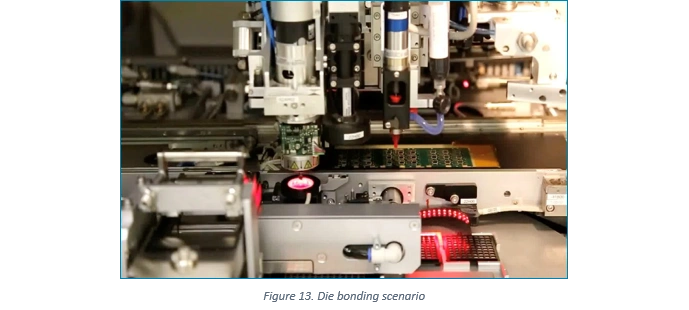
In semiconductor processing, “bonding” refers to attaching a die to a substrate. Die bonding attaches a semiconductor die to a lead frame or printed circuit board (PCB), enabling electrical connection to external circuits. This process places stringent demands on the precision and stability of motion control.

- Motion control and machine vision software run on a single industrial computer, with high-speed shared memory enabling faster data exchange and function execution.
- A single controller supports up to 64-axis motion control with a 125 µs EtherCAT cycle, powered by Intel® processors and high-performance drive management.
- Machine logic, motion, and vision control programs run entirely in the INtime real-time system, improving execution stability and machine efficiency.
- Advanced algorithms from the ISG CNC library, including feedforward and vibration suppression, combined with Intel® processor computing power, enhance machine stability and efficiency.
4.2 High-Flexibility Trajectory Control in 3D Dispensing
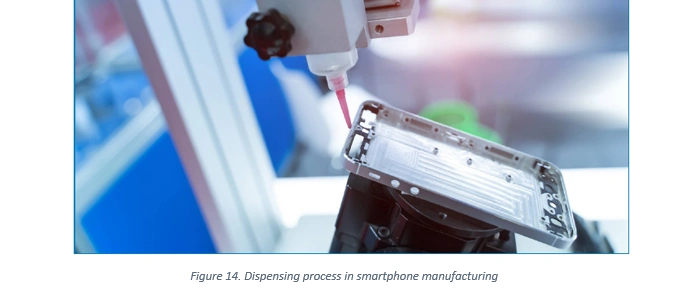
Dispensing is an important industrial process that applies electronic adhesives, oils, or other liquids to products for bonding, encapsulation, insulation, fixing, or surface finishing. Modern manufacturing demands increasingly high dispensing accuracy and trajectory control, posing greater challenges for motion control.
Advantages of the NoTime controller for dispensing:
- Integrates a dispensing interface and supports direct CAD file import to generate motion commands.
- Industry-leading look-ahead, spline path, and HSC functions from the ISG CNC library meet demanding trajectory control requirements.
- The ISG CNC library supports 5-axis RTCP and over 50 kinematic transformation models.
- Built-in FPGA-based fast I/O enables precise valve timing, including early valve opening/closing and PWM valve control, for advanced dispensing applications.
5 Outlook
The ProU NoTime controller pairs a real-time-system-based machine program execution environment and motion function library with Future Robot’s high-performance, high-stability, high-expandability industrial computers, leveraging Intel® technologies for fully real-time machine control. Its modular, software-based architecture enables flexible customization and easy performance scaling across Intel® processors.
Building on these capabilities, ProU will deepen collaboration with Intel and Future Robot to further innovate the NoTime controller, including the introduction of a vibration suppression package and the Virtuos simulation environment. These innovations will address increasingly refined and complex motion control requirements, helping enable flexible, intelligent production lines and accelerate manufacturing transformation.
About ProU
ProU is a leading provider of commercially deployed x86-based machine control software platforms in Asia. Founded in 2015, ProU has grown rapidly in sales and customer base. Its vision is to enable fully real-time x86-based machine control by decoupling machine logic, motion, vision, and data processing from general-purpose operating systems—delivering performance and stability beyond conventional embedded controllers.
About Future Robot
Founded in 2017, Future Robot is a national-level high-tech enterprise specializing in industrial control, machine vision, and automation. With proprietary technologies and fast customization capabilities, Future Robot develops and manufactures embedded computing products and system solutions for industrial automation, digitalization, and intelligent manufacturing.
About Intel
Intel (NASDAQ: INTC), a global technology leader, creates world-changing technologies that advance global progress and enrich lives. Guided by Moore’s Law, Intel continues to advance semiconductor design and manufacturing. By bringing intelligence to the cloud, network, edge, and computing devices, Intel unlocks the potential of data and helps create a better future for businesses and society.
Actual performance may vary depending on use, configuration, and other factors. Learn more at www.Intel.com/PerformanceIndex.
Performance results are based on testing as of the dates shown in configurations and may not reflect all publicly available security updates. See configuration disclosure for details. No product or component can be absolutely secure.
The costs and results may vary.
Intel technologies may require enabled hardware, software, or service activation.
Intel makes no representations or warranties of any kind, express or implied, including without limitation warranties of merchantability, fitness for a particular purpose, or non-infringement, as well as any warranty arising from course of performance, course of dealing, or usage in trade.
Intel does not control or audit third-party data. You should review this content, consult other sources, and confirm whether referenced data is accurate.
© Intel Corporation. Intel, the Intel logo, and other Intel marks are trademarks of Intel Corporation or its subsidiaries in the U.S. and/or other countries. Other names and brands may be claimed as the property of others.
We’re just a message away! Let us help with your needs.